Summer, 2026, Cyberspace
Join us this summer on Zoom to present your research to the CDEV Community. We will host the seminar on the first Monday of the month from May to August (May 4, June 1, July 6). The session will consist of two 25-minute presentations, followed by questions.
This is a great opportunity to hear exciting research and engage with the community, especially if you are unable to attend this year’s SMB Annual Meeting in Graz, Austria!
To join click here
Sincerely,
Your CDEV Subgroup Officers
Upcoming: 6th of July 2026 (8:00-9:00 EST)
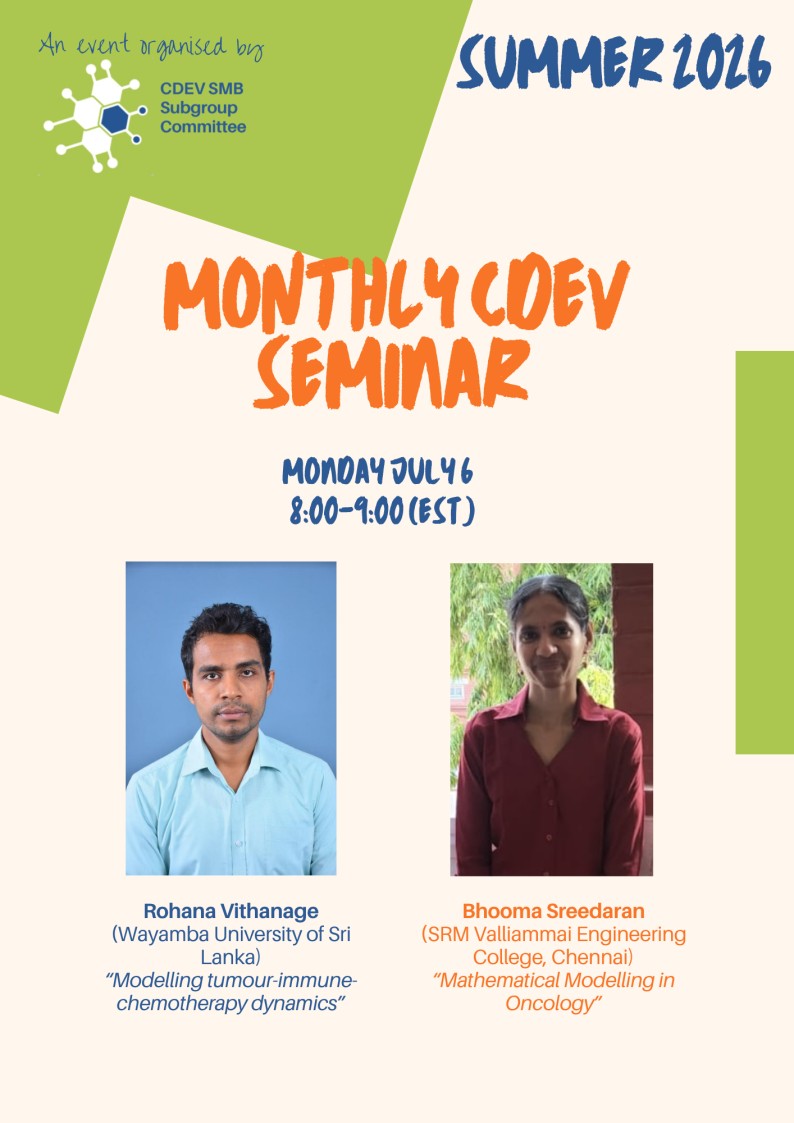
Rohana Vithanage (Wayamba University of Sri Lanka)
Modelling tumour-immune-chemotherapy dynamics
This work investigates an optimal control framework for a tumor–immune–chemotherapy model to explore strategies that improve treatment outcomes while minimizing drug toxicity. We consider a system of nonlinear ordinary differential equations describing the interactions among tumor cells, immune effector cells, and chemotherapeutic drug concentration. The model incorporates tumor growth, immune response, and drug-induced cytotoxic effects. Pontryagin’s Maximum Principle is applied to derive the necessary conditions for optimal treatment strategies. The resulting optimality system is solved numerically using a forward–backward Runge–Kutta scheme. The objective functional balances tumor reduction and immune preservation against the cost and side effects of chemotherapy. In addition, a sensitivity analysis is performed to evaluate the influence of key biological parameters on treatment outcomes and to assess the robustness of the optimal control strategy.
Numerical simulations demonstrate that the optimal therapy protocol significantly reduces tumor burden while maintaining immune activity and limiting excessive drug usage. The results highlight the importance of treatment timing and dosage scheduling in achieving effective cancer control. Overall, this study provides a quantitative framework for exploring chemotherapy optimization and contributes to the development of mathematically guided cancer treatment strategies.
Bhooma Sreedaran (SRM Valliammai Engineering College, Chennai)
Mathematical Modelling in Oncology
Mathematical Oncology is an Interdisciplinary field combining Mathematics, Biology, and Medicine that uses quantitative methods to understand cancer dynamics and to develop predictive models for tumor behavior. The key components include: Mathematical modeling of biological processes, Statistical analysis of clinical data, Computational simulations of tumor evolution, and Optimization of treatment protocols.
In this talk, I will explore some of these aspects.
To join click here
1st of June 2026 (11:00-12:30 EST)
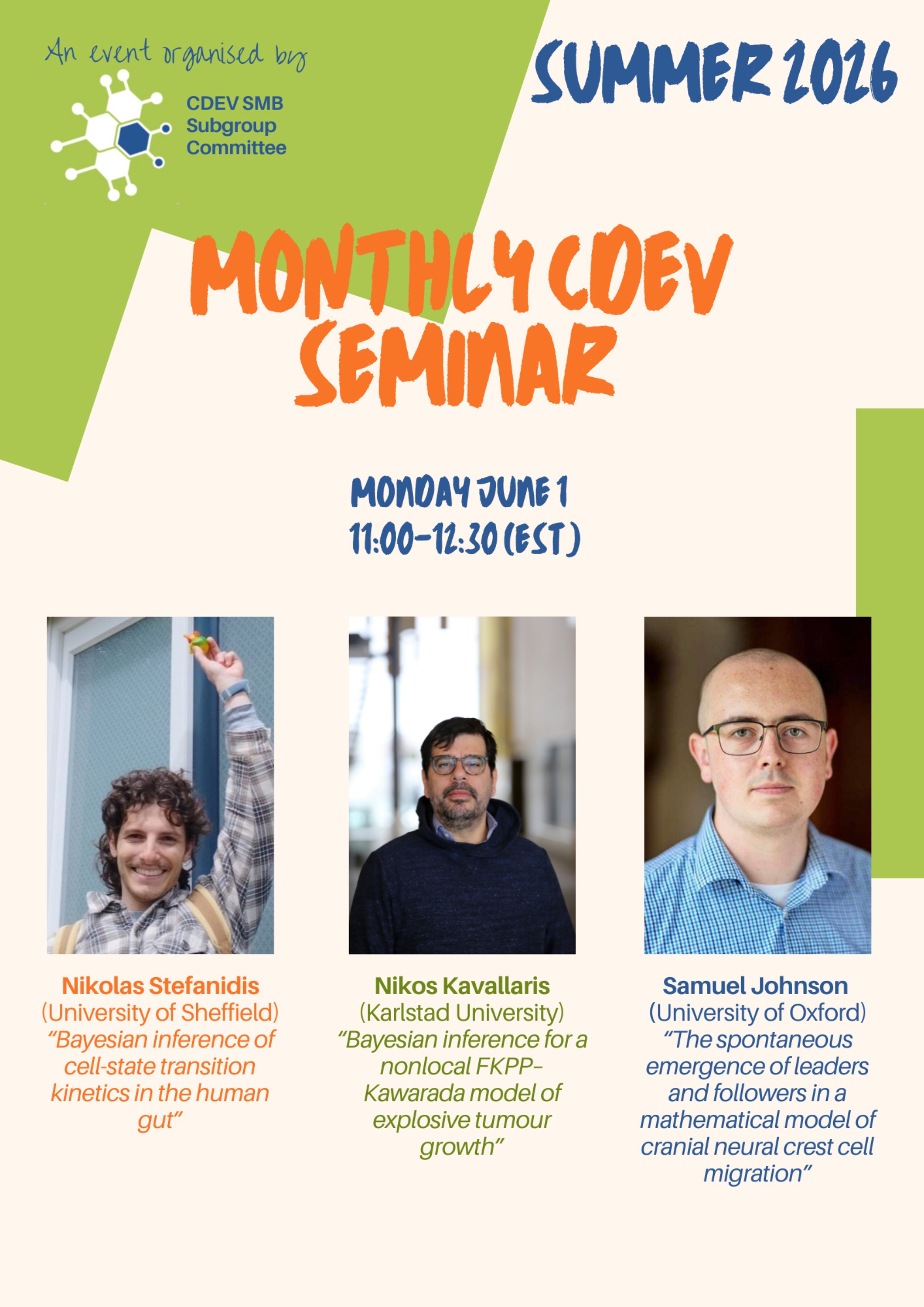
Nikolas Stefanidis (University of Sheffield)
Bayesian inference of cell-state transition kinetics in the human gut
The enteric nervous system (ENS), often referred to as the “second brain,” is a complex network of neurons lining the gastrointestinal tract that independently regulates digestion, motility, and nutrient absorption. The formation of the ENS relies on a spatiotemporally regulated sequence of cell proliferation, migration, and differentiation. This process can be viewed as a dynamical system where bipotent ENS progenitors transition into specialised neuronal and glial states. The Notch signalling pathway is qualitatively known to influence these transitions, consistent with the implication of Notch signalling dysregulation in neurological gut pathologies such as Hirschsprung’s disease. However, the precise kinetics and regulatory logic governing these cell state transitions - particularly in human cells - remain poorly quantified.
In this work, we investigate the role of Notch signalling in controlling the rate of differentiation. Using an in vitro human pluripotent stem cell (hPSC) differentiation platform of ENS development, we generate high-resolution longitudinal data under normal conditions and following Notch signalling attenuation. We propose a computational framework to describe these differentiation kinetics, modelling the system as a series of coupled ordinary differential equations representing transitions between discrete cellular states. We then employ parameter inference techniques to quantify how Notch signalling modulates transition rates toward neuronal versus glial lineages.
Our results demonstrate that Notch serves as a critical “brake” on differentiation; its attenuation shifts the system’s equilibrium, leading to premature differentiation of the bipotent progenitor pool. This quantitative approach offers a robust basis for understanding the mechanistic origins of neurological gut dysfunctions through the lens of disrupted developmental kinetics.
Nikos Kavallaris (Karlstad University)
Bayesian inference for a nonlocal FKPP–Kawarada model of explosive tumour growth
We develop a Bayesian inference framework for a nonlocal FKPP–Kawarada quenching model of explosive tumour growth. The forward model is a logistic reaction–diffusion PDE with homogeneous Neumann (no-flux) boundaries, where the proliferation rate depends on a spatial convolution of the cell density. A singular (accelerating) dependence on this convolved density induces quenching: the cell density remains bounded while the reaction term diverges as a nonlocal quantity approaches a critical threshold. This mechanism provides a parsimonious way to represent rapid escalation in growth without unphysical blow-up of the state.
Samuel Johnson (University of Oxford)
The spontaneous emergence of leaders and followers in a mathematical model of cranial neural crest cell migration
In the chick embryo, cranial neural crest cells migrate collectively in streams, with ‘leader’ cells at the front guiding ‘followers’ behind. However, it is unclear whether these identities are specified prior to, or during, migration. To address this question, we develop an agent-based model in which all cells obey identical rules of movement and carry a polarity vector that evolves according to time-averaged exposure to chemoattractant gradients. We show that, without prescribing any cell a distinct identity, leader and follower phenotypes can arise spontaneously from the underlying collective dynamics, suggesting that these identities need not be specified prior to migration.
4th of May 2026 (12:00-13:00 CST)
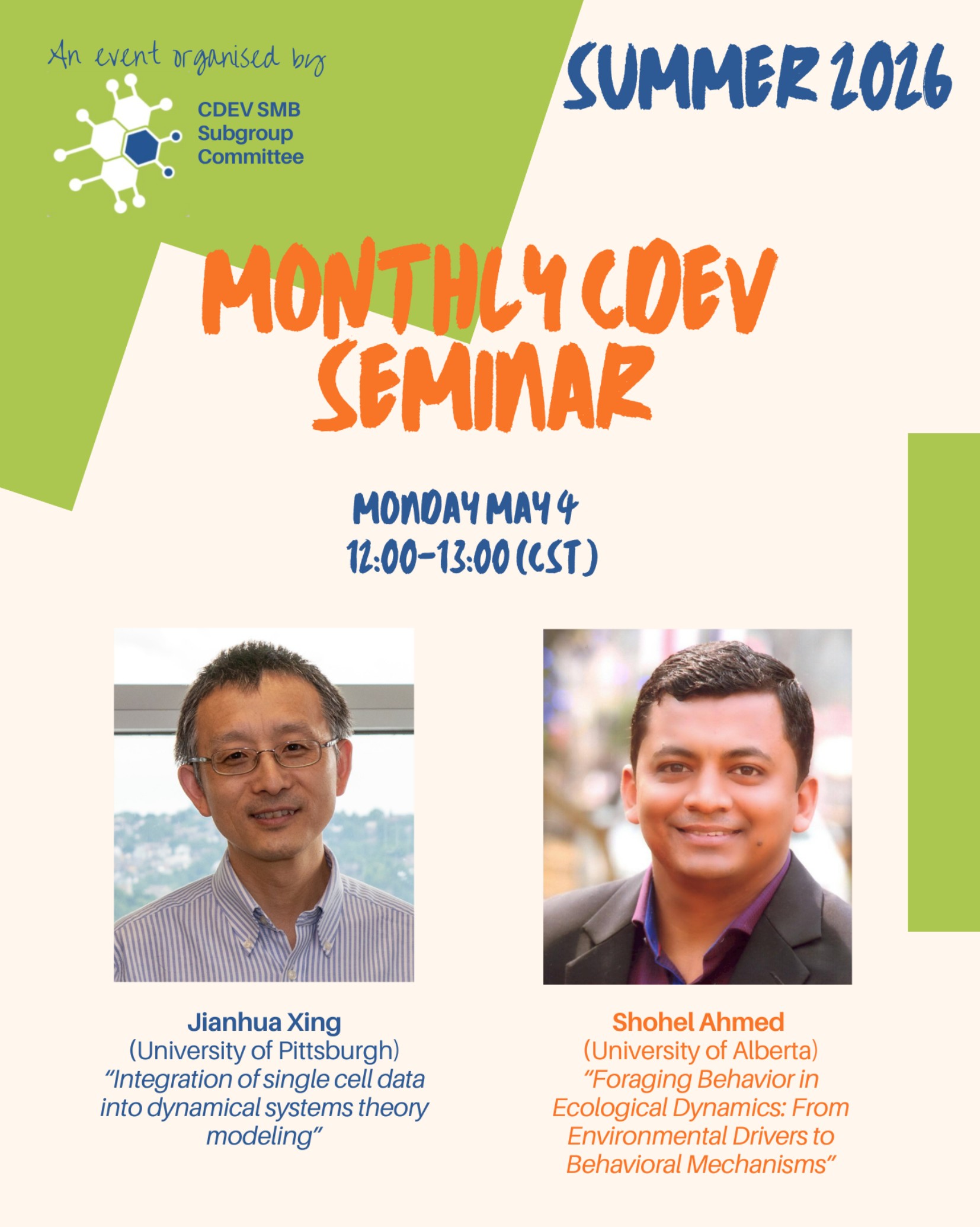
Jianhua Xing (University of Pittsburgh)
Integration of single-cell data into dynamical systems theory modeling
Dynamical systems theories have long been applied in modeling cellular processes. Over the years, my lab has been developing theoretical and computational approaches for integrating high-throughput single-cell data into constructing data-driven mechanistic biophysics-based whole-cell models. We notice that it only takes a few minutes on a desktop to reconstruct a biophysical whole-cell model from scRNAseq data. Even without any prior knowledge as input, the model reveals detailed regulatory programs, and simulated trajectories even show cell cycle arrest at various cell cycle checkpoints. In this talk, I will introduce the framework we developed, then focus on recent developments.
Shohel Ahmed (University of Alberta)
Foraging Behavior in Ecological Dynamics: From Environmental Drivers to Behavioral Mechanisms
Foraging behavior is inherently flexible, with individuals adapting feeding strategies in response to environmental conditions such as resource availability and predation risk. We develop mechanistic models linking environmental drivers to behavioral responses in consumer–resource systems. First, we examine feedback between foraging intensity, resource density, and competition. We then incorporate continuous variation in behavioral phenotypes, capturing differences in individual boldness. Our results show that behavioral flexibility and trait variation can stabilize population dynamics, influence species coexistence, and enhance ecosystem resilience under environmental change.